


Guide to HID to LED Warehouse Lighting Uprades
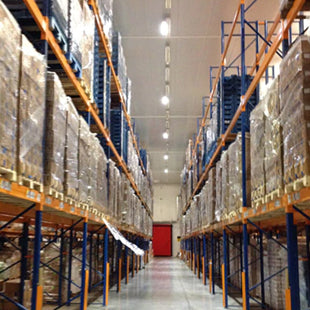
HID to LED warehouse lighting upgrades involve replacing metal halide (MH) and other high-intensity discharge lighting (HID) fixtures with LED lighting systems to improve energy efficiency, light quality, reliability, and maintenance performance in existing warehouse facilities.
Many warehouses still rely on legacy lighting installed years or decades ago. While metal halide and other HID systems were once the standard for high-bay applications, they present significant limitations in modern operations. This guide explains how to plan and execute an HID to LED warehouse lighting upgrade, including what changes to expect, common pitfalls, and how to maximize performance and savings. It supports the broader framework outlined in Warehouse & Distribution Center Lighting: A Comprehensive Guide for New Construction, Renovations, and Retrofits.
Why Warehouses Replace HID Lighting with LEDs
Compared to HID lighting, LED warehouse systems use less energy, provide better light distribution and color quality, require far less maintenance, and support modern lighting controls—making them ideal for retrofit projects.
HID lighting systems were designed for durability, but they fall short of modern warehouse requirements.
Common limitations of HID lighting include:
- High energy consumption relative to delivered light
- Long warm-up and restrike times after power interruptions
- Significant lumen depreciation over time
- Poor color rendering and yellow-orange light output
- Frequent maintenance due to lamp and ballast failure
LED lighting addresses these issues while supporting safer, more efficient warehouse operations.
Key Benefits of HID to LED Upgrade
Replacing HID fixtures with LEDs delivers multiple operational advantages.
Typical benefits include:
- 40–70% reduction in lighting energy use
- Instant-on performance with no warm-up delay
- Improved visibility due to better color rendering
- More consistent light levels over time
- Reduced maintenance and downtime
In high-hour facilities, these benefits compound quickly.
Understanding the Differences: HID vs LED Lighting
HID and LED systems behave very differently in warehouse environments.
Key differences include:
- Light output: HID output degrades steadily, while LEDs maintain usable output for most of their rated life
- Color quality: LEDs provide whiter light that improves visual clarity
- Control compatibility: LEDs work effectively with dimming and controls; HID does not
- Energy efficiency: LEDs deliver more usable light per watt
These differences should be accounted for when planning a retrofit.
Successful HID to LED warehouse retrofits focus on lighting performance and layout, not on one-for-one fixture replacement. Because LED fixtures distribute light differently than HID, matching wattage or lumen ratings alone often leads to over-lighting, glare, or uneven coverage.
A design-based retrofit approach ensures the upgraded system improves visibility, efficiency, and long-term reliability.
Key Planning Steps for an Effective Upgrade
-
Evaluate existing mounting heights and spacing
HID fixtures were often spaced widely and mounted high to compensate for poor optical control. LED retrofits should assess whether existing spacing supports uniform illumination with modern optics. -
Identify task zones and light level requirements
Different warehouse areas—such as bulk storage, aisles, picking zones, and loading docks—require different light levels. Retrofit planning should align LED output and distribution with actual task needs. -
Select appropriate fixture types and optics
Choosing between linear and UFO high bays, and selecting the correct beam angles or aisle optics, is critical to improving vertical illumination and reducing wasted light. -
Review electrical infrastructure compatibility
Retrofits should confirm voltage, wiring condition, and control compatibility. In some cases, LED drivers and controls can be integrated into existing circuits without major electrical changes.
Why Design Matters More Than One-for-One Replacement
HID fixtures emit light omnidirectionally, while LEDs provide directional, controlled output. Replacing a 400W HID with a similarly rated LED fixture without optical planning often results in:
- Excessive brightness and glare
- Poor vertical illumination on racks
- Higher energy use than necessary
A design-based approach delivers better visual performance and lower operating costs.
Facility managers often benefit from professional layout and fixture selection assistance during retrofits. ELEDLights works with warehouse operators and facility managers to help plan LED warehouse lighting retrofits, evaluating existing conditions, recommending appropriate fixtures, and supporting rebate-eligible designs.
Effective HID to LED warehouse retrofits focus on lighting design, fixture selection, and task requirements rather than one-for-one replacement, resulting in better visibility and lower energy use.
HID vs. LED Warehouse Lighting: Before and After Retrofit Comparison
|
Category |
HID Warehouse Lighting (Before) |
LED Warehouse Lighting (After) |
|---|---|---|
|
Typical Wattage |
250W–400W (plus ballast losses) |
95W–320W (driver included) |
|
Energy Efficiency |
Low (≈60–100 lm/W system efficiency) |
High (≈140–170+ lm/W) |
|
Light Distribution |
Omnidirectional, uncontrolled |
Directional, optically controlled |
|
Vertical Illumination |
Poor visibility on racks and labels |
Strong vertical illumination with proper optics |
|
Warm-Up Time |
Several minutes to reach full output |
Instant-on at full brightness |
|
Color Quality (CRI) |
Low (≈20–25 CRI) |
High (70–80+ CRI) |
|
Color Consistency |
Color shifts over lamp life |
Stable CCT over lifespan |
|
Maintenance Frequency |
Frequent lamp and ballast replacements |
Minimal maintenance for 50,000–100,000+ hours |
|
Controls Compatibility |
Limited or impractical |
Fully compatible with dimming, sensors, and zoning |
|
Typical Use Case |
General illumination with limited precision |
Task-optimized lighting matched to warehouse zones |
|
Operational Impact |
Downtime during re-lamping |
Reduced downtime and lift usage |
|
Overall Cost of Ownership |
High long-term cost |
Significantly lower lifecycle cost |
What to Replace First: HID to LED Retrofit Priority List
When retrofitting HID to LED warehouse lighting, prioritize high-ceiling, high-maintenance, and long-hour operating areas first to achieve the fastest energy savings, maintenance reduction, and safety improvements.
Not all warehouse areas deliver the same return when retrofitted. Prioritizing the right zones first helps facilities capture energy savings faster, reduce maintenance risk, and improve safety with minimal disruption.
1. High-Maintenance, High-Ceiling Areas (Top Priority)
Why first:
These areas are the most expensive and disruptive to maintain.
Replace HID fixtures first in:
- High-bay storage areas
- Tall racked aisles
- Spaces requiring lifts or scissor equipment
Benefits:
- Immediate reduction in lamp and ballast replacements
- Lower labor and lift costs
- Improved visibility at height
This is often where LED retrofits pay for themselves fastest—even before energy savings are considered.
2. 24/7 or Long-Hour Operating Zones
Why next:
High run hours magnify energy and maintenance costs.
Prioritize:
- Main warehouse floors
- Continuous picking or replenishment zones
- Facilities operating multiple shifts or 24/7
Benefits:
- Rapid energy savings due to high operating hours
- Instant-on LEDs eliminate warm-up delays common with HID
- Better light quality during overnight shifts
3. Task-Critical Areas Affecting Accuracy and Safety
Why it matters:
Poor lighting directly impacts errors, injuries, and productivity.
Target:
- Picking and scanning aisles
- Packing and inspection stations
- Conveyor and sortation areas
Benefits:
- Improved color rendering and visibility
- Fewer picking and labeling errors
- Better depth perception and worker comfort
These areas often see the most noticeable performance improvements after retrofit.
4. Loading Docks and Shipping Areas
Why next:
Docks combine safety risk, glare challenges, and inconsistent daylight.
Replace fixtures in:
- Dock doors and loading bays
- Trailer interiors (with dedicated dock lights)
- Staging lanes near doors
Benefits:
- Improved visibility during trailer entry and exit
- Reduced glare for forklift operators and drivers
- Better performance across changing daylight conditions
Additional Considerations:
Older or Failing HID Systems
Why practical:
Some systems are already costing more to keep running than to replace.
Look for:
- Frequent lamp or ballast failures
- Color shift or dim output
- Long warm-up or restrike delays
Replacing these systems early prevents escalating maintenance costs and unplanned downtime.
Areas with Rebate or Incentive Opportunities
Why strategic:
Utility incentives can accelerate ROI.
Focus on zones where:
- High wattage reduction qualifies for rebates
- DLC-listed fixtures are eligible
- Controls can be added for additional incentives
Retrofit planning that aligns with rebate programs often allows larger projects to be completed sooner.
Retrofit Planning Tip
Rather than retrofitting everything at once, many facilities phase upgrades by priority. ELEDLights helps facility managers plan phased HID to LED warehouse retrofits, identifying high-impact zones first and aligning fixture selection with energy savings, maintenance reduction, and available rebates.
Fixture Selection for HID Retrofits
Linear LED High Bays
Linear high bays are commonly used to replace HID and high-output fluorescent fixtures in racked warehouses, where light distribution and uniformity matter more than raw output.
Advantages:
- Improved vertical illumination on shelving and rack faces
- Better uniformity with fewer fixtures
- Compatibility with aisle-optimized optics
Because of these characteristics, linear LED high bay fixtures often allow facilities to reduce wattage while improving overall visibility in retrofit applications.
UFO (Round) LED High Bays
UFO high bays are frequently used to retrofit open warehouse floors and large spaces where wide coverage is required.
Considerations:
- Beam angle selection is critical to avoid wasted light
- Narrow or medium optics often outperform wide distributions in mixed-use spaces
- Fixture quality and thermal management directly affect longevity
When matched correctly to layout and ceiling height, UFO LED high bay fixtures provide an effective and efficient replacement for legacy HID systems in open areas.
Optics and Distribution in Retrofit Projects
In HID to LED warehouse retrofits, optical control is more effective than increasing wattage. Proper distribution often improves visibility and eliminates the need for additional fixtures.
Optical control is one of the most significant advantages LED lighting offers over legacy HID systems. HID fixtures emit light in all directions and rely on reflectors to shape output, while LED fixtures use precision optics to deliver light exactly where it is needed.
In retrofit projects, taking advantage of this optical control often delivers greater performance gains than simply increasing fixture output.
Best Practices for Optical Selection in Retrofits
Effective LED retrofit designs focus on distribution first, not wattage.
Key best practices include:
- Using aisle-optimized optics in racked storage areas to improve vertical illumination on shelving and labels
- Avoiding wide-beam fixtures that spill light above racks or into unused space
- Adjusting optical distribution to match aisle width, rack height, and mounting height rather than increasing wattage
These strategies allow LEDs to illuminate working areas more efficiently than HID, even at lower power levels.
Why Optics Reduce Fixture Count
Because LEDs direct light more precisely, proper optics often:
- Improve uniformity without tighter spacing
- Reduce shadowing between racks
- Eliminate the need to add fixtures to “fill in” dark areas
In many retrofit projects, proper optical selection allows existing fixture locations to be reused while achieving better visibility than the original HID system.
Electrical and Installation Considerations
HID to LED warehouse retrofits typically reuse much of the existing electrical infrastructure, which helps limit installation complexity and cost. However, several electrical and installation factors should be reviewed to ensure the upgraded system performs reliably and meets long-term operational needs.
Common considerations:
- Verify voltage compatibility, as warehouses may operate on 120–277V or 277–480V systems depending on building age and electrical design
- During installation, HID ballasts must be removed or bypassed, since LED drivers operate differently and leaving ballasts in place can cause performance issues or premature failures
- Mounting hardware and fixture spacing may also require adjustment, as LED fixtures often deliver better optical control and may not need to match original HID locations exactly
- Retrofit planning should account for minimizing downtime during changeover, especially in active or 24/7 facilities where lighting outages can disrupt operations and safety
Over time, LED retrofits generally simplify electrical systems, reducing component count, eliminating ballast maintenance, and improving compatibility with modern controls and monitoring technologies.
Controls and Energy Savings Opportunities
LED retrofits enable controls that were impractical with HID lighting.
Common options include:
- Occupancy sensors for low-traffic aisles
- Dimming for secondary zones
- Scheduling for shift-based operations
Controls can significantly increase energy savings when applied selectively.
Utility Rebates and Incentives for LED Retrofits
Many utilities offer incentives specifically for replacing HID fixtures with LEDs, particularly in high-hour warehouse environments. These programs can significantly reduce upfront project costs and accelerate return on investment.
Incentives may include:
- Rebates based on fixture wattage reduction
- Additional incentives for lighting controls
- Programs targeting high-hour or 24/7 facilities
Facilities evaluating rebate opportunities can learn more in Utility Rebates for LED Retrofits: What Commercial Buyers Should Know, which explains how rebate programs work and what documentation is typically required.
Rebates often improve payback timelines and help make phased retrofit projects more financially viable.
Common Mistakes in HID to LED Upgrades
- One-for-one replacement without redesign
- Over-lighting based on initial LED brightness
- Ignoring optics and vertical illumination
- Selecting fixtures based solely on price
- Poor commissioning of controls
Avoiding these mistakes is critical to retrofit success.
Summary: Successful HID to LED Warehouse Upgrades
Effective HID to LED warehouse lighting retrofits focus on design alignment, optical control, and lifecycle performance rather than simple fixture replacement. When properly planned, LED retrofits deliver lasting improvements in visibility, energy efficiency, and maintenance reduction.
Next Steps
- Explore LED high bay lighting Replacements for HID
- Request a quote for high bay lights for your facility: Call or text 858.650.9400, email lights@eledlights.com, or use our handy quote request form.
Frequently Asked Questions About HID to LED Warehouse Upgrades
Can HID lights be replaced directly with LED fixtures?
Yes, but a direct one-for-one replacement is not always optimal. LEDs should be selected based on layout, optics, and required light levels rather than matching HID wattage.
How much energy can be saved by replacing HID with LEDs?
Most warehouse LED retrofits reduce lighting energy use by 40–70%, depending on operating hours and fixture selection.
Do LED lights work with existing warehouse wiring?
In most cases, yes. LED high bays are designed to operate on common warehouse voltages, and ballasts are removed during installation.
Are lighting controls required when retrofitting to LEDs?
Controls are not always required, but they can significantly increase energy savings and are often incentivized by utility rebate programs.
How long does it take to see payback from an LED retrofit?
Payback timelines commonly range from 1–3 years in high-hour warehouses, depending on energy rates, rebates, and project scope.
This guide is intended for educational and planning purposes. Final retrofit performance depends on site conditions, fixture selection, and installation quality.