


Warehouse Aisle & Racking Lighting Design: Reducing Shadows and Improving Uniformity

Lighting warehouse aisles and racked storage areas presents challenges that differ significantly from open warehouse floors. Tall shelving, narrow aisles, and high mounting heights can easily create shadows, glare, and uneven light distribution if fixtures and optics are not carefully selected.
This guide explains how to design effective warehouse aisle and racking lighting, with a focus on reducing shadows, improving vertical illumination, and achieving uniform light levels that support safety, accuracy, and efficiency. It serves as a detailed companion to Warehouse & Distribution Center Lighting: A Comprehensive Guide for New Construction, Renovations, and Retrofits.
Why Aisle and Racking Lighting Requires Special Design
Unlike open storage areas, warehouse aisles introduce vertical surfaces that must be illuminated clearly.
Key challenges include:
- Tall racking that blocks lateral light spread
- Narrow aisle widths that amplify glare
- High mounting heights that increase shadowing
- Forklift traffic requiring clear floor visibility
- Picking and scanning tasks that depend on vertical illumination
Inadequate aisle lighting can lead to reduced picking accuracy, increased safety risk, and visual fatigue for workers.
Horizontal vs. Vertical Illumination in Warehouse Aisles
In warehouse aisles, horizontal illumination supports navigation, but vertical illumination determines how well workers can see shelving, labels, and inventory. Effective aisle lighting design balances both to improve safety, accuracy, and efficiency.
Many warehouse lighting issues occur because lighting design focuses almost exclusively on horizontal foot-candles measured at floor level, while overlooking how light interacts with shelving and stored materials.
In racked warehouse aisles, visibility is three-dimensional. Workers, forklifts, and scanning systems rely not only on light on the floor, but on light reaching vertical surfaces such as rack faces, pallet loads, and labels.
Horizontal Illumination
Horizontal illumination measures the amount of light reaching walking and driving surfaces.
- Supports navigation and forklift operation
- Important for overall safety
- Alone, it does not ensure visibility of rack faces or labels
Horizontal light levels are important for safety and code compliance, but by themselves they do not ensure operational visibility in racked environments.
Vertical Illumination
Vertical illumination measures light delivered to upright surfaces, including shelving, cartons, and labels.
- Illuminates shelving, pallets, and labels
- Improves barcode scanning and inventory identification
- Is critical in narrow aisles with tall racking
Vertical illumination measures light delivered to upright surfaces, including shelving, cartons, and labels.
Why Vertical Illumination Is Often Under-Designed
Traditional warehouse lighting approaches relied on wide-beam fixtures and floor-based measurements. In modern racked warehouses, this often leads to:
- Light being trapped above racks
- Strong contrast between aisle floors and shelving
- Over-lighting the floor while rack faces remain dim
Effective aisle lighting shifts focus from “how bright the floor is” to how evenly light is distributed throughout the aisle volume.
Designing for Balance: The Best Practice
Effective warehouse aisle lighting balances both horizontal and vertical illumination, rather than maximizing one at the expense of the other.
Best-practice strategies include:
- Aligning fixtures directly over aisle centerlines
- Using aisle-optimized optics that direct light down and across rack faces
- Selecting linear high bay fixtures where vertical distribution is critical
- Designing for uniformity, not just average foot-candles
- When both planes are addressed together, warehouses achieve:
- Better visibility at lower total wattage
- Faster, more accurate picking
- Improved safety without excessive brightness
Common Causes of Shadows in Warehouse Aisles

Shadows in racked warehouse aisles are most often the result of lighting design and fixture selection, not a lack of total lumen output. In many cases, aisles with adequate average foot-candles still suffer from poor visibility due to uneven light distribution.
Frequent causes include:
- Wide-beam fixtures used in narrow aisles: Broad distributions spread light beyond the aisle, leaving rack faces and lower shelf levels under-illuminated.
- Fixture spacing that does not align with aisle centers: When fixtures are positioned between aisles instead of directly over them, shelving blocks light and creates alternating bright and dark zones.
- Mounting heights that exceed optical control capabilities: Fixtures not designed for high mounting heights lose beam control, causing light to spill above racks instead of reaching the working area.
- Racks blocking cross-aisle light: Fixtures not designed for high mounting heights lose beam control, causing light to spill above racks instead of reaching the working area.
- Over-reliance on general-area lighting: Using open-area fixtures to light aisles rarely provides sufficient vertical illumination on shelving or labels.
Simply increasing wattage or fixture count rarely eliminates shadows and often introduces new problems such as glare, uneven brightness, and wasted light. Effective aisle lighting focuses on optical control and fixture placement, not just higher output.
Choosing the Right Optics for Warehouse Aisles
In warehouse aisles, aisle-optimized optics provide superior vertical illumination and uniformity, while medium distribution optics are best reserved for wider aisles or lower mounting heights where shelving is less dense.
Optical distribution is one of the most important—and often misunderstood—factors in warehouse aisle lighting design. The same fixture can perform very differently depending on the optics used, especially in racked environments where light must reach both the floor and vertical shelving surfaces.
Narrow and Aisle-Optimized Optics
Aisle-optimized optics are designed to direct light down the length of the aisle rather than spreading it outward into adjacent spaces or above racking.
These optics typically use asymmetric beam patterns that shape light into a rectangular distribution aligned with aisle geometry.
Benefits include:
- Reduced light spill above racking
- Improved vertical illumination on shelving faces
- More consistent light levels from the top to the bottom of racks
- Better uniformity from top to bottom of racks
- Lower required lumen output compared to wide optics
Common aisle distributions include asymmetric patterns such as 60×110° or 50×90°, which are especially effective in narrow aisles with tall racking..
Medium Distribution Optics
Medium distribution optics provide a moderately wide beam designed to balance forward throw and lateral spread. They are broader than aisle optics but more controlled than wide or flood distributions.
Medium beam angles may be appropriate when:
- Aisles are wider
- Racking heights are moderate
- Fixtures are mounted at lower heights
- The space serves both aisle and open-floor functions
In these scenarios, medium optics can provide acceptable horizontal illumination while still delivering some light to vertical surfaces, but they often struggle in very tall or narrow aisle environments. As aisle height increases, medium optics tend to spill more light above racking, reducing efficiency and uniformity.
Best-Practice Guidance for Warehouse Aisle Optics
For most racked warehouse aisles:
- Aisle-optimized optics are preferred for narrow aisles and tall racking
- Medium distribution optics are better suited for wider aisles or mixed-use zones
Choosing optics that match aisle geometry often delivers better visibility without increasing wattage or fixture count.
Fixture Types for Aisle and Racking Lighting
Linear LED High Bays

LED linear high bay
Linear high bays are commonly preferred for aisle lighting due to their geometry and optical flexibility.
Advantages:
- Compatible with dedicated aisle lenses
- Even light distribution along aisle lengths
- Better vertical coverage than round fixtures
- Easy alignment over rack rows
Linear fixtures are especially effective in fulfillment centers and distribution centers with dense racking.
UFO (Round) LED High Bays
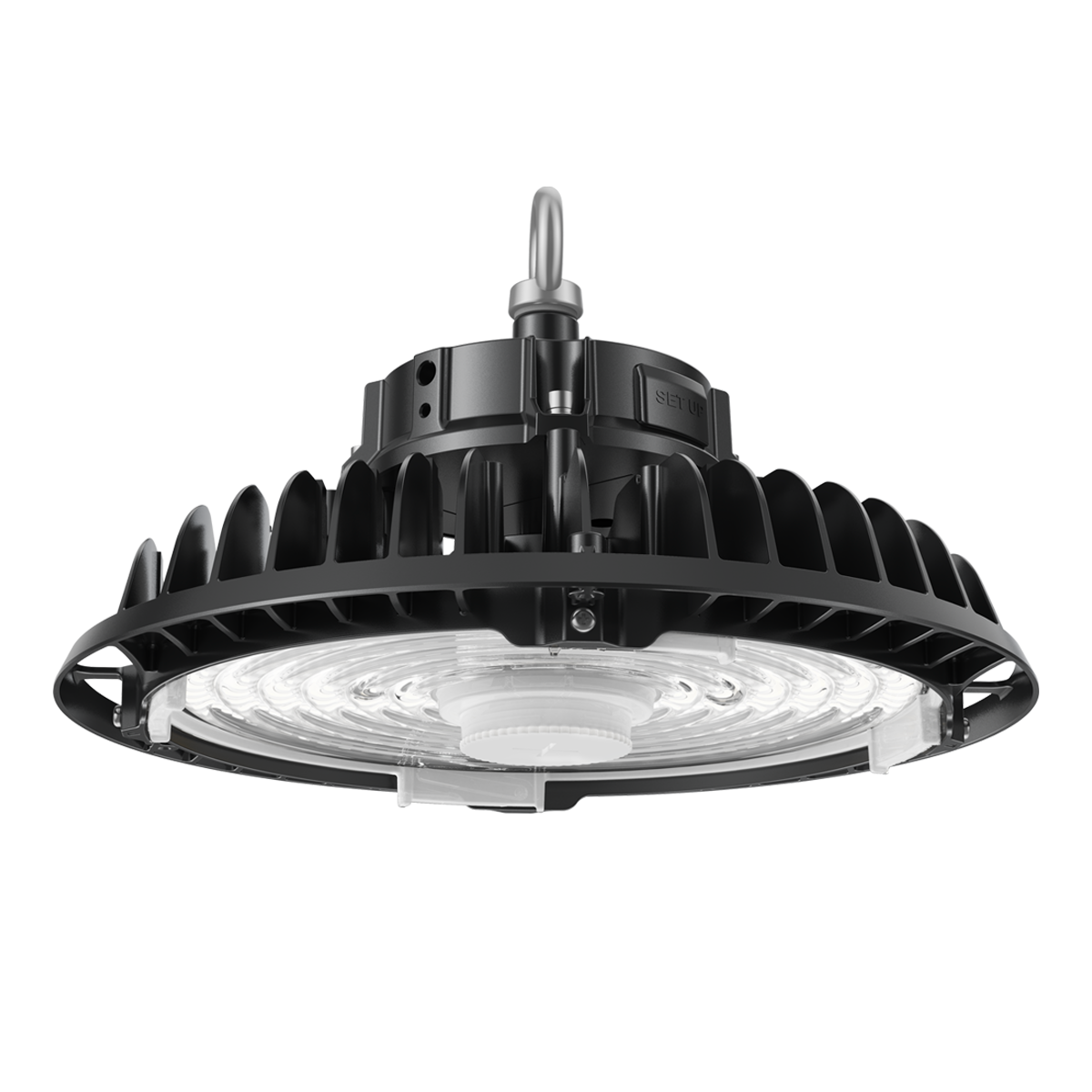
UFO LED high bay
UFO high bays can be used in aisle environments when paired with appropriate optics.
Considerations:
- Narrow beam angles are required for tall racks
- Performance varies significantly by optic quality
- Often better suited to open areas than tight aisles
UFO fixtures without aisle-optimized optics frequently contribute to shadowing in racked storage.
Fixture Placement and Spacing Strategies
Correct fixture placement is just as important as fixture selection in warehouse aisle lighting. Even the best optics cannot compensate for poor alignment or inconsistent spacing, especially in tall racked environments.
Best Practices for Aisle Fixture Placement
✓ Align fixtures directly over aisle centerlines
Fixtures should be centered in the aisle to ensure light is delivered evenly to both rack faces. Off-center placement often results in one side of the aisle being over-lit while the opposite side remains dim.
✓ Maintain consistent spacing along aisle runs
Uniform spacing helps prevent alternating bright and dark zones that reduce visibility and increase eye strain. Inconsistent spacing is a common cause of shadowing and uneven vertical illumination.
✓ Avoid fixture placement that straddles rack tops
Mounting fixtures above racking rather than above aisles allows shelves to block light before it reaches working areas. This often leads to wasted light above racks and poor illumination where it’s needed most.
✓ Coordinate fixture layout with racking plans
Lighting layouts should be designed around final racking configurations whenever possible. Changes in aisle width, rack height, or orientation can significantly affect lighting performance if not accounted for in advance.
Spacing: Design vs. Rules of Thumb
While general spacing guidelines can be useful during early planning, final fixture spacing should be determined using photometric analysis rather than fixed ratios or wattage assumptions.
Photometric design allows for:
- Accurate prediction of horizontal and vertical light levels
- Evaluation of uniformity across the full aisle height
- Optimization of fixture count without over-lighting
This approach helps ensure the lighting system meets operational needs efficiently, without unnecessary wattage or excess fixtures.
Recommended Light Levels for Warehouse Aisles
Warehouse aisle light levels should be based on task requirements, with most aisles operating effectively at 20–50 foot-candles. Uniformity and vertical illumination often improve visibility more than higher brightness alone.
Appropriate light levels in warehouse aisles depend on task intensity, aisle geometry, and racking height, not just square footage. Higher foot-candle targets are not always better if light is uneven or poorly distributed.
Typical Light Level Guidance
-
General warehouse aisles:
20–30 foot-candles
Suitable for low-activity storage aisles and vehicle movement where picking is infrequent. -
Active picking aisles:
30–50 foot-candles
Common in warehouses with regular order selection, case picking, or replenishment tasks. -
High-accuracy or scanning zones:
40+ foot-candles
Recommended where barcode scanning, label verification, or detailed identification is required.
These targets reflect average maintained light levels and should be adjusted based on aisle width, mounting height, and racking density.
Why Uniformity Matters More Than Peak Brightness
In tall, narrow aisles, uniformity and vertical illumination often have a greater impact on visibility than increasing average foot-candles.
Poorly designed lighting can produce:
- Bright floors with dim rack faces
- Strong contrast between upper and lower shelving
- Visual fatigue caused by uneven brightness
Balanced illumination across both horizontal and vertical surfaces allows warehouses to meet visibility needs without excessive wattage or glare.
Best-Practice Guidance for Warehouse Aisle Light Levels
Rather than pushing foot-candle levels higher, effective aisle lighting design focuses on:
- Delivering light where tasks occur
- Maintaining consistent light levels along the full aisle height
- Matching optics and spacing to racking geometry
This approach improves safety, accuracy, and efficiency while minimizing energy use.
Glare Control in Narrow Aisles
Glare is a common complaint in warehouse aisles due to high brightness and direct sightlines.
Strategies to reduce glare include:
- Using optics with controlled cutoff angles
- Avoiding overpowered fixtures
- Maintaining appropriate mounting heights
- Selecting diffused or lens-based distributions
Reducing glare improves comfort for forklift operators and pickers while supporting safer operations.
New Construction vs. Retrofit Aisle Lighting
New Construction
New facilities allow aisle lighting to be designed around:
- Final racking layouts
- Optimized fixture spacing
- Integrated controls and zoning
This approach typically yields the best uniformity and lowest long-term energy use.
Retrofit Projects
Retrofits often work within existing constraints such as:
- Fixed wiring locations
- Legacy fixture spacing
- Operational downtime limitations
In these cases, selecting fixtures with swappable aisle optics or adjustable distributions can significantly improve performance without rewiring.
Controls and Zoning for Aisle Lighting
Lighting controls can enhance aisle performance when applied carefully.
Common approaches:
- Occupancy sensors with reduced standby levels
- Zoning by aisle rather than entire warehouse sections
- Avoiding aggressive dimming in active picking aisles
Controls should support energy savings without creating frequent light level changes that disrupt work.
Common Mistakes in Warehouse Aisle Lighting
- Treating aisle lighting the same as open-area lighting
- Using wide-beam fixtures over tall racking
- Ignoring vertical illumination requirements
- Over-lighting to compensate for poor optics
- Designing without considering final rack layout
Avoiding these mistakes often delivers better results than increasing fixture wattage.
Summary: Effective Aisle and Racking Lighting Design
Well-designed warehouse aisle lighting prioritizes optical control, vertical illumination, and proper placement over raw lumen output. By aligning fixtures with aisle geometry, selecting appropriate optics, and targeting uniform light levels, facilities can reduce shadows, improve safety, and support accurate picking.
This approach applies across warehouses, distribution centers, and fulfillment centers, with increasing precision required as activity density increases.
Next Steps
- Explore high bay lighting for aisles and racking
- Get a free professional lighting layout for your facility
- Request a quote for high bay lights for your facility: Call or text 858.650.9400, email lights@eledlights.com, or use our handy quote request form.
Frequently Asked Questions About Warehouse Aisle & Racking Lighting
How do you reduce shadows in warehouse aisles?
Shadows in warehouse aisles are reduced by using aisle-optimized optics, aligning fixtures directly over aisle centerlines, and prioritizing vertical illumination on rack faces rather than increasing overall wattage.
What type of lighting is best for warehouse racking aisles?
Linear LED high bays with dedicated aisle optics are typically best for racking aisles because they provide controlled, directional light that improves vertical visibility on shelving and reduces wasted light above racks.
How many foot-candles are needed in warehouse aisles?
Most warehouse aisles require 20–30 foot-candles, while active picking or scanning aisles may require 30–50 foot-candles depending on task complexity and accuracy requirements.
Why is vertical illumination important in warehouse aisles?
Vertical illumination improves visibility of labels, pallets, and shelving, supporting accurate picking and safer forklift operation. Horizontal floor lighting alone does not provide sufficient visibility in tall racked environments.
Can UFO high bays be used for warehouse aisles?
Yes, UFO high bays can be used in warehouse aisles if they are equipped with narrow or aisle-focused optics and mounted correctly. However, linear high bays are often preferred for narrow or densely racked aisles due to better optical control.
Is aisle lighting different for retrofits versus new construction?
Yes. New construction allows aisle lighting to be designed around final racking layouts, while retrofits often rely on adjustable optics or swappable lenses to improve performance within existing wiring and spacing constraints.
This guide is intended for educational and planning purposes. Final lighting performance depends on site conditions, racking layout, and fixture specifications.