


Choosing LED Retrofit Kits for Fluorescent Fixtures
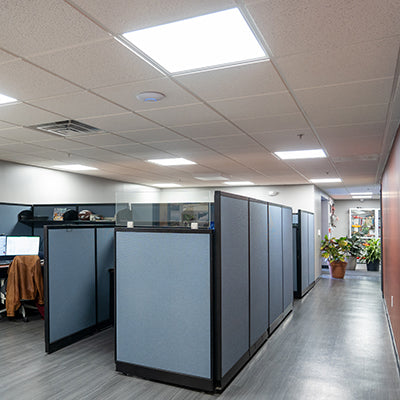
Choosing LED retrofit kits for fluorescent fixtures is one of the most important steps in a successful commercial lighting upgrade. The right retrofit kit improves energy efficiency, light quality, and long-term reliability, while the wrong choice can result in glare, uneven illumination, or avoidable maintenance issues.
This guide explains how to choose an LED retrofit kit for fluorescent lights, how retrofit kits compare to LED tube replacements, and what factors matter most when upgrading commercial fluorescent fixtures.
This guide supports our LED Retrofit Lighting: Complete Guide for Commercial Buildings , which covers retrofit strategies across common commercial fixture types.
What Is an LED Retrofit Kit for Fluorescent Fixtures?
Quick Answer: An LED retrofit kit for fluorescent fixtures replaces T8/T12 lamps and magnetic/electronic ballasts with an LED light engine, LED driver, and mounting hardware designed to fit inside existing 2×2, 2×4, 4-foot, or 8-foot fluorescent housings—improving efficiency by 50-65% while maintaining or improving light quality.
Quick definition: An LED retrofit kit replaces the internal components of a fluorescent fixture—such as lamps and ballasts—with an LED light engine and driver designed to fit inside the existing housing.
Unlike simple LED tube replacements, retrofit kits are engineered to work with the fixture itself, improving:
- Light distribution
- Uniformity
- Visual comfort
- Long-term reliability
LED retrofit kits are commonly used for:

2×2 and 2×4 fluorescent troffers

4-foot and 8-foot linear fluorescent fixtures

Industrial strip and utility fixtures
Why Choosing the Right LED Retrofit Kit Matters
Quick Answer: Poor retrofit kit selection causes glare complaints, uneven light distribution, dark zones, and premature failures. The right kit matches your fixture's housing depth, mounting method, and reflector design while delivering appropriate light levels, uniformity, and visual comfort for your specific application.
Fluorescent fixtures vary widely in housing depth, reflector design, mounting method, and application. Choosing an LED retrofit kit without evaluating these factors can lead to:
- Uneven light levels or dark zones
- Increased glare compared to fluorescent lighting
- Inconsistent color temperature across fixtures
- Poor visual comfort in offices or classrooms
- Reduced perceived performance despite energy savings
Selecting the right retrofit kit helps ensure the LED upgrade delivers both efficiency and usable light quality.
Key Factors to Consider When Choosing an LED Retrofit Kit
When choosing an LED retrofit kit for fluorescent fixtures, the most important factors are fixture compatibility, light distribution, glare control, and operating conditions.
Existing Fixture Type and Condition
Understanding your existing fixture specifications is essential for retrofit compatibility. Commercial fluorescent fixtures typically follow ANSI standards for lamp dimensions and electrical characteristics, which helps ensure proper retrofit kit selection and safe installation.
Start by confirming:
- Fixture size (2×4 troffer, 4-foot strip, 8-foot strip)
- Housing depth and mounting method
- Condition of reflectors, lenses, and mounting surfaces
Fixture condition note:
The performance of any LED retrofit depends on the condition of the existing fixture housing and optics. Damaged or degraded fixtures may require repair or replacement to achieve expected results.
Light Output and Distribution Requirements
Choosing a retrofit kit is not just about lumen output. Consider:
- Ceiling height
- Fixture spacing
- Task type (general lighting vs detailed work)
- Room or aisle layout
Two retrofit kits with similar lumen ratings can perform very differently depending on beam angle and optical design.
Uniformity and Glare Control
Uniform, well-diffused light improves comfort and safety in commercial spaces. Poorly selected retrofits can create bright hot spots or excessive glare—especially when replacing fluorescent lamps. Retrofit kits designed specifically for fluorescent housings typically provide better uniformity and glare control than lamp-only conversions.
According to the Illuminating Engineering Society (IES), evaluating light distribution and uniformity is a core principle of good lighting design, particularly in commercial and task-oriented environments. (IES)
Electrical Compatibility and Installation Approach
Some LED retrofit kits require:
- Ballast removal or bypass
- Line-voltage wiring
- Fixture relabeling after modification
Installation complexity should align with available maintenance resources, downtime constraints, and safety and electrical code considerations.
Operating Hours and Maintenance Access
Facilities with long operating hours or difficult fixture access benefit most from retrofit kits that reduce component failures and minimize maintenance interventions. In these environments, reliability often outweighs small differences in upfront cost.
LED Retrofit Kits vs LED Tube Replacements
Quick Answer: LED retrofit kits provide superior light distribution, glare control, and 10+ year lifespan by replacing all internal components. LED tubes cost 40-60% less but depend on existing reflectors, often create more glare, and have shorter lifespans. Kits are best for commercial spaces; tubes work for budget-limited projects.
When upgrading fluorescent fixtures, LED retrofit kits and LED tube replacements are often compared, but they differ significantly in light quality, longevity, and suitability for commercial environments.
Table 1: LED Retrofit Kits vs LED Tube Replacements (Commercial Fluorescent Fixtures)
| Comparison factor | LED retrofit kits | LED tube replacements |
|---|---|---|
| Components replaced | Lamps, ballasts, internal optics | Lamps only |
| Fixture design alignment | Designed for the housing | Dependent on existing reflector |
| Light distribution | Even and controlled | Can be uneven |
| Glare potential | Lower | Often higher |
| Typical lifespan | Longer | Varies by tube |
| Common use | Commercial, high-use spaces | Smaller or cost-limited projects |
Key Takeaway: LED retrofit kits typically deliver more predictable performance and light quality in commercial fluorescent fixtures than LED tube replacements.
Table 2: When to Choose Each Option
| Choose LED retrofit kits when… | Choose LED tube replacements when… |
|---|---|
| Uniformity and glare control are important | Budget is the primary driver |
| Fixtures operate long hours | Operating hours are limited |
| Maintenance access is difficult | Fixtures are easy to access |
| Consistent lighting is required | Visual demands are modest |
| Project spans many fixtures | Project scope is small |
Choosing Retrofit Kits by Application
Different environments prioritize different lighting outcomes:
- Offices & classrooms: glare control, uniformity, visual comfort
- Warehouses & industrial spaces: durability, distribution, and reliability
- Healthcare & administrative areas: consistent color and low visual fatigue
Table 3: Recommended Retrofit Approach by Application
| Application | Primary retrofit priority |
|---|---|
| Offices & classrooms | Uniformity and glare control |
| Warehouses | Distribution and durability |
| Healthcare | Visual comfort and consistency |
| Industrial spaces | Reliability and lifespan |
| Administrative areas | Balanced output and comfort |
These differences explain why retrofit kits are often selected for commercial fluorescent upgrades where lighting quality and long-term performance matter.
Using Photometric Layouts to Validate Retrofit Selection
Quick Answer: Photometric layouts simulate expected light levels, uniformity ratios, and glare potential before installation using fixture specifications, mounting heights, and room dimensions. They prevent costly mistakes by identifying dark zones, excessive brightness, and spacing problems before you buy—especially critical for spaces over 2,000 sq ft.
Photometric layouts simulate how light will behave in a real space based on fixture type, mounting height, spacing, and optics. They are especially useful when selecting retrofit kits for fluorescent fixtures in larger or more complex areas.
Photometric planning note:
Photometric layouts help predict light levels, uniformity, and glare before installation. For customers purchasing lighting through ELEDLights, photometric layouts can be provided at no charge to help ensure retrofit selections perform as expected in real-world spaces.
Photometric planning reduces the risk of glare complaints, under-lighting, and costly adjustments after installation.
When Full Fixture Replacement May Be the Better Option
While retrofit kits are effective in many cases, full fixture replacement may be more appropriate when:
- Fixture housings are damaged or corroded
- Existing optics cause persistent glare or poor distribution
- Lighting layouts need to change
- Compliance requirements cannot be met through retrofit
Frequently Asked Questions
What is an LED retrofit kit for a fluorescent fixture?
An LED retrofit kit replaces internal fluorescent components (such as lamps and ballasts) with an LED light engine and driver designed to fit the existing fixture housing.
Are LED retrofit kits better than LED tube replacements?
In most commercial applications, retrofit kits provide more consistent light distribution and better glare control because they are designed for the fixture housing. LED tube replacements can be appropriate for smaller or budget-driven projects, but results depend more on existing reflectors and installation.
Do I need to remove or bypass the ballast when converting to LED?
It depends on the retrofit approach. Many commercial retrofit kits are designed to bypass or replace the ballast with an LED driver. Installation requirements vary by product and should be confirmed for the specific fixture type and project conditions.
How do I choose the right light output and color temperature?
Start with the space’s use, ceiling height, and desired light levels, then select optics that support uniformity and glare control. Color temperature is often chosen based on the environment (for example, offices frequently use neutral white, while many industrial spaces use a cooler white).
How can photometric layouts help with retrofit selection?
Photometric layouts model expected light levels and distribution based on fixture data, mounting height, and spacing. They help reduce the risk of glare, dark zones, and uneven lighting before installation.
Can ELEDLights recommend retrofit kits based on my existing fixtures?
Yes. The ELEDLights team can review your current fluorescent fixtures and the space’s lighting needs to recommend retrofit options aligned with performance goals, operating conditions, and installation constraints.
Next Steps: Selecting the Right Retrofit Kit
Choosing LED retrofit kits for fluorescent fixtures is a practical way to modernize lighting while managing cost and disruption. The best outcomes come from aligning retrofit selection with fixture type and application needs.
- Explore LED retrofit solutions for fluorescent fixtures
- LED Retrofit Options for 2×4 Troffer Fixtures
- Replacing Fluorescent Bulbs With LED: What to Know
- Request guidance on retrofit compatibility and planning: Call or text 858.650.9400 or email lights@eledlights.com.
Still need help? The ELEDLights team can evaluate your existing fluorescent fixtures and space requirements to recommend retrofit options aligned with lighting needs, operating conditions, and performance goals.